
Interior brick: keep it visible, paint it or change the room?
Decide what to do with an interior brick wall in Spain. Compare paint and reversible changes, investigate damp and test a compatible finish before work.
An exposed brick wall can be your favourite detail or the surface that complicates every decorating choice. Its colour creates no obligation to preserve or paint it. Your preference and the material’s condition should guide the decision.
For a home in Spain, separate the material, its condition and its intended role in the room.
Name the problem before choosing a finish
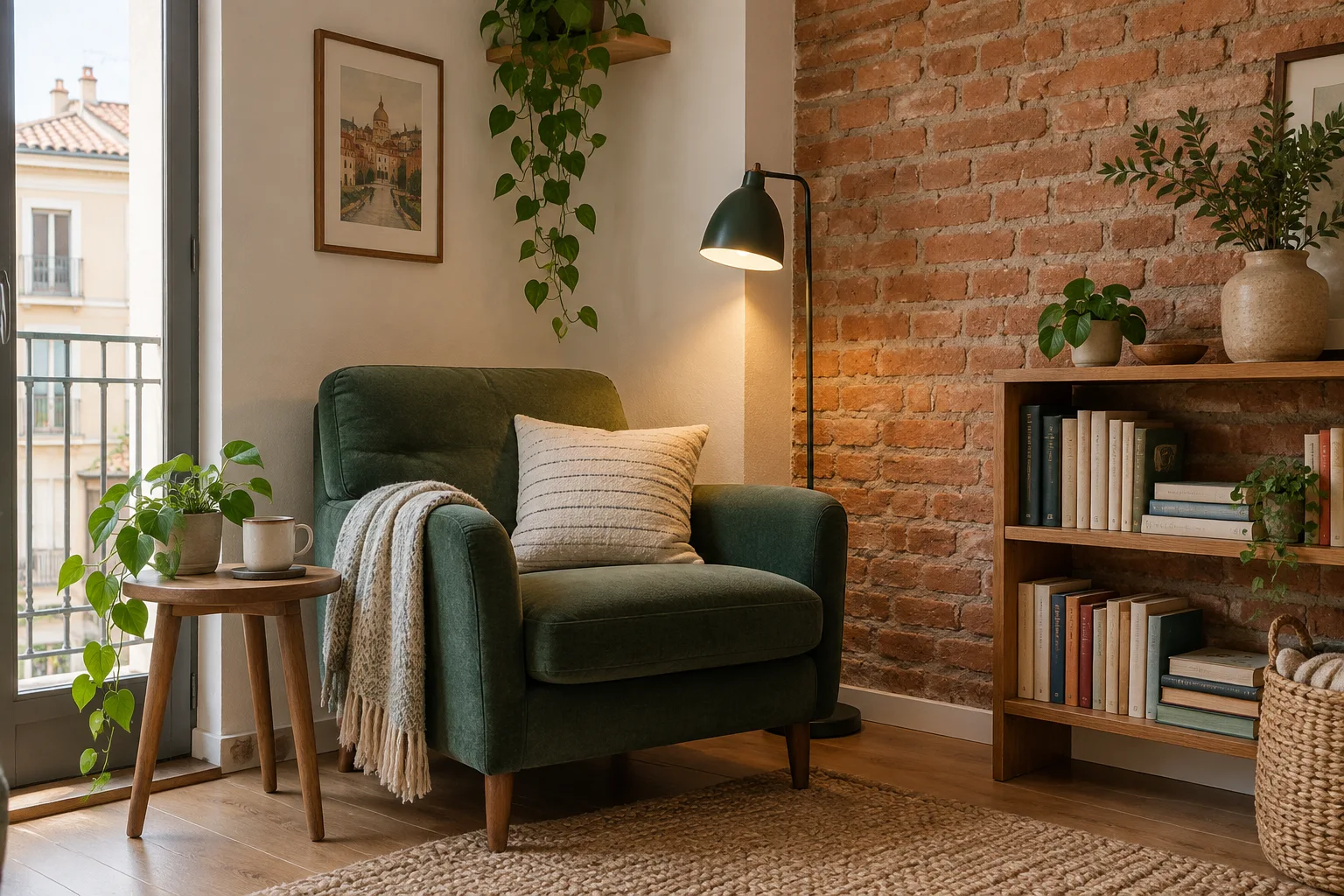
Decide whether you dislike the colour, roughness, repairs or visual prominence. These are different problems. Uniform colour can quieten the pattern but cannot make uneven masonry smooth. Discuss concerns about touch or cleaning separately from colour.
Identify masonry, brick slips or decorative imitation, and any previous coating. Photograph repairs and contrasting areas. Set one goal: calmer background, retained variation or less visible brick. Compare wall colour choices with the brick, floor and furniture.
Investigate damp before selecting a coating
Recurring marks, deposits, flaking or musty smells warrant investigation before decoration. Record their location and timing, including after rain or prolonged closure. Give these observations to the assessor without treating them as a diagnosis.
Moisture treatment should address its cause, which requires investigation. Ask what was checked, what repair is proposed and how readiness for finishing will be established. The guide to condensation helps frame questions but cannot exclude a leak. Wait until the cause is resolved and the substrate ready.
Source: Historic England · Investigation of moisture and its effects on traditional buildings
Choose how much change you want to commit to
Removing paint from brick can be difficult and damage the surface. Treat an applied finish as a lasting choice. Painting only part of the wall limits its extent, not its permanence. The genuinely changeable alternatives operate around the brick: furniture, curtains, artwork or a different colour on an adjacent wall.
| Option | Visual result | Main commitment | Useful first step |
|---|---|---|---|
| Keep brick visible | Retains colour variation | Accepting the existing surface | Review it with the room furnished |
| Opaque paint | More uniform colour | A lasting coated surface | Approve a compatible trial patch |
| Mineral wash or partial coating | Selective or softer colour change | Still alters the treated brick | Test the exact product and boundary |
| Change the surroundings | Different balance around the wall | Movable or separately painted elements | Try lighting and adjacent colours |
Source: Historic England · Redecoration and removal of coatings from masonry
Specify a system for this substrate
Read the current technical sheet for the proposed product. Coatings require the stated substrate condition; a clean, dry and sound base matters. Ask the supplier to confirm suitability for your brick, mortar and any existing finish. The words mineral, washable or breathable do not describe a complete preparation and application system.
Get the proposed cleaning, local repairs, primer if required, finish and drying sequence in writing. Avoid a universal recipe for dilution or coat count. Do not assume a transparent sealer leaves the appearance unchanged or can simply be removed later.
Source: KEIM · Innotop-Grob technical data sheet: substrate conditions
Use separate tests for colour and application
Start with a movable colour board beside the brick. If you choose painting, agree a discreet on-wall trial with the complete preparation and finish, including brick and mortar. This patch already changes the surface: choose its position deliberately.
Review the dry trial in daylight and under your usual evening lighting. Look at joint coverage, texture, sheen and the intended cleaning method. A successful visual patch does not prove that a damp wall is ready. Decide exactly where the treatment stops, including corners and the junctions with skirting boards and door trim.
Price the preparation and keep the decision record
Specify protection, access, cleaning, repairs, the coating system and cleanup. Define included areas and treatment around switches and adjoining finishes. Photograph the accepted trial and record products; that describes the order better than a colour name.
If changing the surroundings already gives the room what you wanted, use those ideas in a refresh without major building work. For coating, the materials calculator can organise a quantity estimate, but roughness, absorption and the product's application guidance still need checking. Do not turn the calculated quantity into a guaranteed purchase or an installed price.
Common questions
Must red brick stay unpainted?
No colour creates a universal design rule. Judge your own room and the wall's condition. Preserving it is a sensible starting point when you remain undecided because you can still choose a coating later.
Is a diluted white finish reversible?
Do not assume so. A thin or translucent coating still changes the treated surface. Use removable furnishings or adjacent colour changes if preserving future options is your priority.
Can I skip preparation if the wall looks clean?
Appearance does not establish compatibility. Identify the substrate and old finishes, then follow the selected system's requirements. The trial should include the proposed preparation, not just the final colour.
Make the smallest change that solves your problem
Decide the desired effect, resolve the wall's condition and compare a room adjustment with an approved coating sample. Commit when the result and the preparation are both clear.
Planning work on an interior brick wall?
Tell us about the wall in your home in Spain and the result you want. Request a free preliminary estimate for the proposed work.
The article and enquiry topic are included automatically, so you do not need to repeat them.
Loading the enquiry form…
Discuss my wall
Sources and editorial approach
Editorial guide prepared with AI assistance. Labelled scenarios are planning examples. Check your property’s circumstances before commissioning work. Sources checked on September 22, 2026.