
Vintage kitchens: what to restore and what to replace
Keep the character of a vintage kitchen while checking cabinets, appliances and services. Decide what to restore before commissioning a retro replacement.
A kitchen can feel worth saving because of a glazed cupboard, a familiar drawer handle or the proportions of its doors. That attachment is a useful starting point, but it does not tell you whether the hidden cabinets can support another renovation.
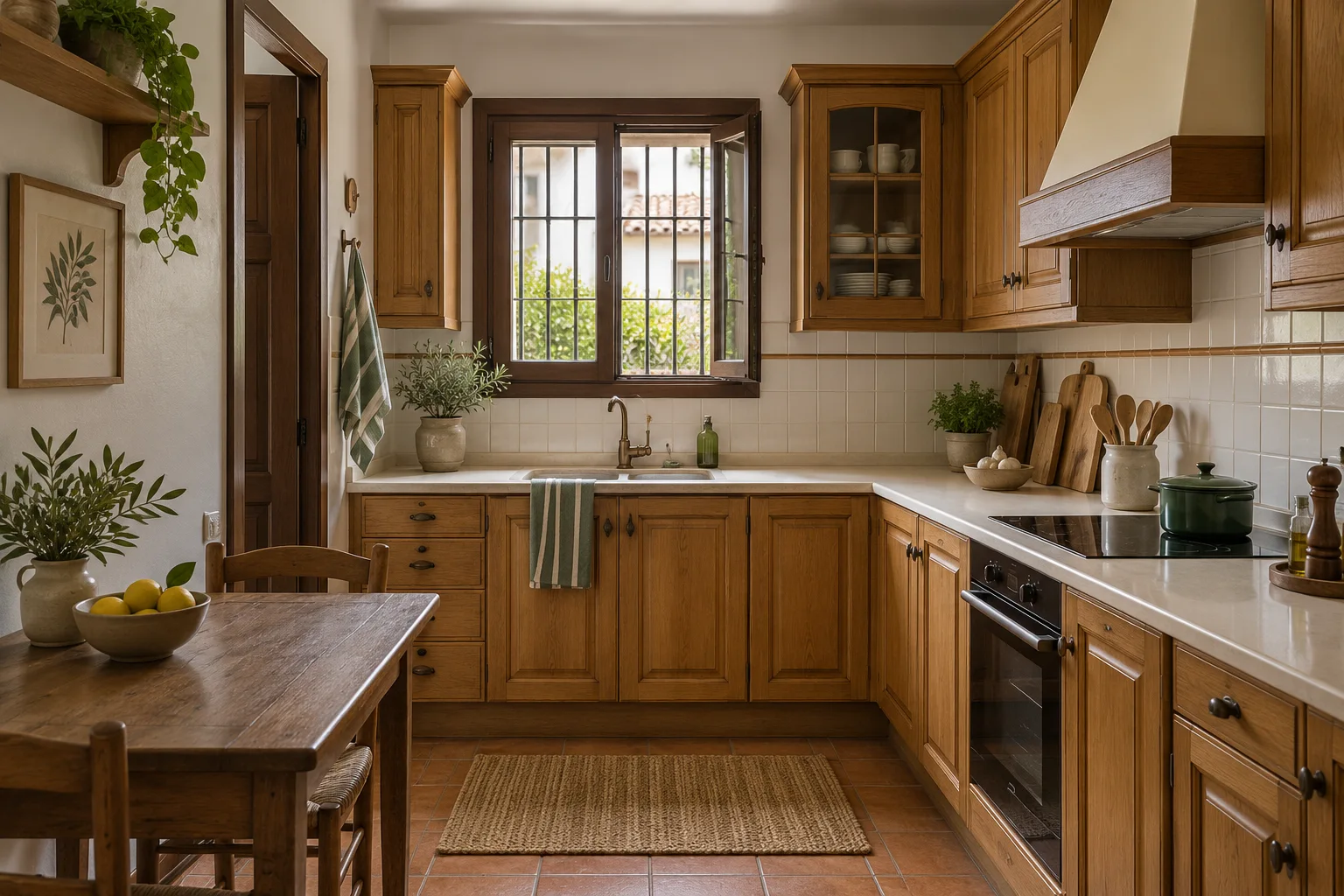
For a home in Spain, separate the character you value from the condition of the construction. You can preserve original pieces, build a new kitchen with retro details, or combine both. Each route needs a different brief.
Choose what you mean by vintage
Write down the actual features you would miss: a door profile, a freestanding cupboard, a tiled panel or a particular handle. Photograph each separately.
Decide whether original material matters more to you than reproducing its appearance. Restoration may leave visible irregularities, while new retro furniture offers another way to obtain the proportions you like. Use the guide to kitchen styles to describe the visual brief, then mark which decisions depend on genuinely old pieces.
Inspect the cabinet bodies before their fronts
Empty the cabinets and photograph the interiors, undersides and accessible backs. Record swelling, loose joints, leaning shelves, repeated hinge repairs and staining around the sink. These are reasons to investigate, rather than a remote diagnosis. Ask a carpenter to assess stability, fixings, alignment and whether repairs will leave a dependable base for the proposed worktop.
Drawers and appliances may need a different space from the one the old furniture provides. Have the survey identify damaged cabinets individually: one failed sink unit need not decide the fate of the whole room. Keep removal provisional until neighbouring supports and worktop connections have been checked.
Give every component a decision
Use a retain, repair or replace schedule instead of one label for the entire kitchen. For anything being saved, name the work required and who will accept its condition. Compare replacing kitchen fronts only after the bodies have passed assessment; new doors cannot settle a problem inside the cabinet.
In an illustrative proposal, a glazed cupboard remains, its hinges are repaired, and the deteriorated sink cabinet is replaced with a compatible new unit. The original handles set the visual reference for the additions.
| Component | Keep or repair when | Replace or redesign when |
|---|---|---|
| Cabinet bodies | Assessment supports stable, useful reuse | Damage or geometry makes the planned use unsuitable |
| Doors and handles | Condition and fittings permit the intended repair | Repair cannot provide a usable opening or agreed finish |
| Worktop and sink | Condition and new connections have been checked | Damage or altered layout prevents suitable reuse |
| Appliances | Professional assessment and installation fit the plan | Condition, servicing or installation cannot be resolved |
Choose appliances before adapting the furniture
Make a schedule of exact appliance models and obtain their installation drawings. Bosch notes that installation and ventilation requirements vary by model. Ask the supplier to check each proposed housing against the selected appliance, including how it will be accessed for replacement later.
A rounded refrigerator door or enamelled cooker can anchor the look, but first draw its operation in the room. Ask for repair support and replacement-part information for any old appliance you hope to keep. Do not make an unassessed appliance indispensable to a made-to-measure cabinet order.
Give hidden work its own scope
Spain’s REBT distinguishes domestic circuits by use. Ask an authorised installer to assess the existing installation for the proposed appliances and changes. Include a clear list of equipment and intended locations when requesting the electrical renovation assessment.
Record water connections, waste pipes and the intended extraction route on the same drawing as the cabinetry. Ask who disconnects appliances, protects retained pieces and makes good the wall afterwards. If cupboards must come out for service work, include removal, storage and refitting in the quote. Plan these operations before the final paint finish, and agree how newly discovered defects will be documented and priced.
Source: BOE · Reglamento electrotécnico para baja tensión (REBT)
Approve a repair sample and comparable prices
Request a small sample on an agreed inconspicuous area or a removable component, after the finisher has assessed the existing coating. Judge the colour, surface and detail in the kitchen’s light. State which wear marks are welcome and which faults need repair.
Compare restoration and replacement with the same appliances, installation work and finished surfaces. Include transport, fitting, waste removal and any temporary loss of kitchen use. The renovation calculator can organise an initial allowance; it cannot inspect old timber or price hidden repairs.
Common questions
Is restoring old cabinetry always cheaper?
No. Detailed repairs, removal and refitting can change the comparison. Ask for both options with equivalent finished scope, and keep unresolved repairs separate until inspection makes them priceable.
Can I keep the character with all-new cabinets?
Yes. Specify the door proportions, colour and handles you value. An existing freestanding piece can remain the reference without forcing the whole kitchen into its original arrangement.
Should I order replacement doors before the survey?
Wait until cabinet condition, openings and hinge compatibility are established. Otherwise a correct-looking door can become an expensive commitment to a cabinet that needs changing.
Begin with the piece you most want to save
Choose the retained features, commission the cabinet assessment and map the appliance decisions. A convincing vintage kitchen comes from knowing exactly what has earned its place in the next version.
Planning a vintage kitchen in Spain?
Tell us which features you want to retain and what no longer works. Request a free preliminary estimate for the proposed renovation.
The article and enquiry topic are included automatically, so you do not need to repeat them.
Loading the enquiry form…
Request a preliminary estimate
Sources and editorial approach
Editorial guide prepared with AI assistance. Labelled scenarios are planning examples. Check your property’s circumstances before commissioning work. Sources checked on September 22, 2026.